
Motivational interviewing helps people to understand and accept changes in their behavior. Learn about its use, principles and strategies in addiction recovery and mental health treatment.
No matter how emotionally healthy a person is, creating positive behavior changes can be difficult. People may have conflicting feelings about goals like abstaining fromalcohol use, taking medications regularly or losing excess weight. Motivational interviewing provides a safe, empathetic, nonjudgmental way of helping patients understand their internal conflicts about behavior changes and resolve them.
What Is Motivational Interviewing (MI)?
The name may seem straightforward enough, but exactly what is motivational interviewing, and how does it help change people’s behaviors? TheSubstance Abuse and Mental Health Services Administrationdefines motivational interviewing as a way to interact with a client instead of as a set of counseling techniques.
Motivational interviewing is a counseling style based on the assumptions that:
- Ambivalence about change is normal and it can be an obstacle to overcome.
- Ambivalence can be resolved through the client’s motivations.
- The therapist and client are partners, and both bring insights and expertise to the table.
- Empathy, support and direction in counseling can foster behavior change.
History of Motivational Interviewing
The history of motivational interviewing begins in 1983, when clinical psychologist William Miller beganwriting about an approachto help those with problematic drinking. His work also explored the ambivalence these clients expressed aboutstopping alcohol use.
In the late 1980s, Dr. Miller teamed with clinical psychologist Stephen Rollnick, whose early experiences as an addiction treatment nurse had led him to seek better methods to help people with addiction change their behaviors. Drs. Miller and Rollnick drew from psychologist Carl Rogers’ theories about people’s capacity for choices and their ability to self-actualize as well as the Prochaska and DiClementeStages of Changemodel. With these pieces, they co-wrote the book “Motivational Interviewing: Helping People Change” in 1991.
The book became a staple of training, especially in medical settings like primary care. People with chronic conditions can find it hard to make significant changes, but physicians and therapists now had a useful approach for creating the environment to help them make those changes.
How Motivational Interviewing Works
Rather than a strict set of procedures, motivational interviewing techniques are used as a counseling approach. Motivational interviewing is a relational style that puts the client in the driver’s seat, with the therapist as the navigator. When clients discuss their desire to change, the therapist acts without arguing, judging or giving advice. They listen intently, provide feedback as necessary and point out where and when a client seems to be conflicted.
A motivational interviewing example scenario might look like this:
Client:“I know I ultimately want to quit drinking, but I don’t ever seem to get more than a week or two of abstinence before I go back to it.”
Therapist:“It sounds like you would like to change your relationship with alcohol. What do you think life would look like without alcohol in it?”
Client:“I know I wouldn’t be able to socialize or go on dates if I stopped drinking. When I start thinking about that, I can’t really imagine quitting.”
Therapist:“I can see why you’d be conflicted about stopping. You’re worried that alcohol is helping you function in ways you otherwise couldn’t.”
Client:“I hate to say it, but yes. I mean, I know it’s bad for my health, and I’ve already had a DUI.”
Therapist:“Would it be accurate to say that in some ways alcohol has helped you, and in some ways it has harmed you?”
Client:“That’s definitely true. I wish my sister could see it like that so she would stop nagging me about alcohol. I know she means well.”
Therapist:“Perhaps we can figure out how she can talk to you about alcohol in a more acceptable way.”
Client:“That would be a good start.”
Therapist:“Do you think it would help to make a list of the ways alcohol has seemed to help you and ways alcohol has seemed to harm you?”
The therapist’s primary role is to provide support and direction during the motivational interviewing stages. Most importantly, the therapist must be nonjudgmental and understand that the client has the ultimate decision in making the change.
What to Expect
There is no prescribed method for motivational interviewing, and it can take place in a variety of treatment settings. Clients should expect to be asked about:
- Their experiences with trying to change behavior
- Feelings about their current state
- What they would like to change
- What they would like to stay the same
- What they feel is stopping them from changing
- How confident they feel making changes
- How motivated they feel to make changes
Principles of Motivational Interviewing
The “spirit of motivational interviewing” can take place in many treatment settings and it is comprised of four core motivational interviewing principles:
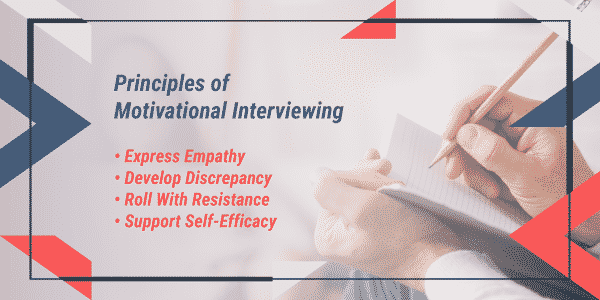
- Express Empathy:The therapist must strive to understand the client’s experience through reflective listening and nonjudgmental acceptance, leaving the ultimate decisions with the client.
- Develop Discrepancy:The therapist can increase a client’s motivation to change by pointing out the difference between the client’s current behavior and the behavior they would like to achieve.
- Roll With Resistance:When a client resists making a change — through denial, rationalization, blaming others or minimizing the problem, for example — the change becomes less likely to happen. The therapist must intervene in a way that both supports the client and gently confronts the resistance.
- Support Self-Efficacy:In order to make changes, clients have to believe that they can do so. The therapist can work in at least two ways here: by supporting the client’s sense of hope, optimism and feasibility, and by helping the client to keep the goals specific, reasonable and attainable.
Motivational Interviewing Strategies
When a therapist or health care professional works with clients on behavior change, they work on creating an alliance with the client through a number of motivational interviewing strategies:
- Open-Ended Questions:The therapist asks questions that cannot be answered with a single-word response. This strategy ensures the therapist receives relevant information and that the client does most of the talking. An example could be “Tell me about your day.”
- Affirmations:The therapist acknowledges a client’s feelings, difficulties or hardships. Examples of affirmations a therapist could give might be “I know it wasn’t easy to come here. You took a big step in doing so.”
- Reflective Listening:Here, the therapist uses their own words to accurately restate what the client said. This process ensures that the therapist truly understands what clients have said and makes them feel heard and seen.
- Summarize:The therapist can periodically give a quick synopsis or interpretation of what a client has stated and invite feedback from clients. This ensures that their concerns are understood.
Goals of Motivational Interviewing
The primary goals of motivational interviewing are to support the client’s motivation to change behavior and have the client commit to making this change. To facilitate these goals, therapists keep several smaller goals in mind:
- Create a sense of active collaboration between the client and therapist
- Identify potential areas for behavior change
- Assess a client’s feelings about changing the behavior
- Provide a supportive environment for the exploration of ambivalence
- Utilize effective strategies to confront resistance and promote self-efficacy
Motivational Interviewing in Addiction and Mental Health Treatment
Motivational interviewing was created for treating addiction. It’s designed to address the potential obstacles people with addiction face when changing behavior. Research has shown that motivational interviewing is effective in this population. The principles of this approach can be used in a wide variety of treatment settings, such as motivational interviewing foralcohol treatmentor motivational interviewing fordepression.
Motivational interviewing provides more opportunities for clients to seek treatment, since addictive behaviors can be addressed earlier in their development. Most importantly, motivational interviewing provides a way for therapists and clients to explore resistance to behavior change in a productive way — without devolving to threats, arguing, criticism or judgment.
If you need help in making important changes, The Recovery Village is here to support you. Our trained therapists will work with you to confront addictive disorders and mental health conditions while making positive changes in your life.Contact us todayto find out more about our programs.